PRINCIPAL'S NOTE
My Constructivist Philosophy of Education
Life Evolves · Society Progresses · Environments Cocreate
Respect
Collaborate
Create
Education is the evolutionary process by which life, in deep interaction with its environment, continuously transcends itself through honoring differences, collaborative construction, and sustained creativity.
PROLOGUE
In 1990, Harvard physics professor Eric Mazur encountered the most humbling moment of his career.
He had taught physics at Harvard for ten years. Student evaluations were stellar—"The professor explains so clearly!" Exam scores were decent, too. Until one day, he gave his students a test called the "Force Concept Inventory"—not a set of calculations, but questions probing their
intuitive understanding of the concept of "force."
The results were devastating. These Harvard students could solve complex physics equations, but when asked a basic conceptual question like "After a ball is thrown into the air and leaves your hand, what forces act on it?", most answered no differently than someone who had never studied physics.
They weren't physics students—they were physics memorizers.
Mazur didn't say "this batch of students just isn't good enough." He turned the question on himself:
"Could it be that something is wrong with how I'm teaching?"
WHY I'M WRITING THIS
I've always been described as someone with "lots of ideas but not very good at expressing them." I've spent nearly twenty years in education, and my mind has accumulated a great deal—how does learning actually happen? How should a school actually operate? Is the relationship between education and biological evolution just a casual metaphor, or is there a genuine underlying connection? These thoughts have drifted through my mind for years, but whenever I tried to articulate them, they crumbled into fragments the moment they reached my lips.
Fortunately, I encountered the age of AI. Over the past while, I've used AI as a coach, interrogating myself again and again: "What are you really trying to say?" "What is the relationship between this and that?" "Can you give an example?" Under its relentless questioning, those thoughts that had been floating around for years were, for the first time, forced into lines, connected into threads, and committed to the page.
The article that follows is the result.
It's raw. It's long. Some parts may still read as a bit abstract. But it is my first attempt to use a unified language to weave "learning"—from the neurons in the brain, to the interactions in the classroom, to the ecological evolution of Yingjian schools, to the rhythm of human societal development—into a single picture.
I call this picture my Constructivist Philosophy of Education. It is not some theoretical framework lifted from a textbook. It is something that grew from within, over twenty years of walking the path of education.
Please tolerate its roughness. I'm still learning how to say things clearly.
"
THEORETICAL FRAMEWORK
A Way of Seeing How the World Works
At its core, the Constructivist Philosophy of Education is one conviction: Learning is not "poured in"—it is "grown out" by the student themselves.
You can explain things brilliantly, but if the student hasn't welded new knowledge onto old experience inside their own mind, if they haven't stumbled through trial and error—then they simply haven't learned. You finish a lesson feeling great about yourself. The students all say they understood. Then the test results come back disastrous. It's not that the students are stupid. It's not that you explained poorly. It's that between "explained well" and "actually learned" there lies a process that only the student can complete.
What Piaget spent his life doing in Geneva was, in essence, discovering a law. The law, stated plainly, is this: people do not learn by "receiving." Children fit new experiences into existing cognitive structures; when something won't fit, they dismantle the structure and rebuild it. It's not "understand first, then remember"—it's "collide first, then reconstruct."
This law is far larger than the classroom.
Cells mutate under environmental pressure—cells are "learning." Species evolve across geological time—species are "learning." The immune system recognizes a pathogen and rebuilds its defenses—the immune system is "learning." A class rule proves unworkable, three months of debate follow, and finally a new solution emerges—the class is "learning." A science undergoes the painful transition from geocentrism to heliocentrism—science is "learning."
Look. They all follow the same path: a system, facing an uncertain environment, adapts through trial and error, selection, and reconstruction—and in the process of adapting, becomes more complex.
My Constructivist Philosophy of Education is me pulling this golden thread back into the domain I care about most.
Why We Need a Larger Framework
In my twenty years of running schools, I've been crashing into three walls every single day—teaching models, parental expectations, and evaluation standards.
They are all too stable. Too entrenched. You can't transform them with a single policy or two rounds of training. Every one of us has been systematically conditioned through the process of socialization—to instinctively avoid mistakes, avoid trying, and pretend to be perfect.
This has forced me to learn how to articulate this education business clearly. Starting from the foundational code. Using one set of algorithms to thoroughly explain: How do students actually grow? How should a school be structured? How can the future genuinely become better?
I say this to my teachers. I say this to my parents. I say this to everyone who wants to truly understand this thing called "learning."
ONE
Biological Evolution Dimension
Learning is "evolution" in the brain
Honor each person's cognitive rhythm
TWO
Social Evolution Dimension
Schools are "grown," not built
Collaboratively construct educational meaning
THREE
Environmental Coevolution Dimension
Subject and environment shape each other
Create new ecological relationships
Core Logic: Variation → Selection → Retention
"
"I know constructivism is correct, but why are the results so inconsistent?"
> Biological Dimension answers: Learning is evolution, and evolution is punctuated equilibrium. Plateau phases are the system accumulating.
"Why does it work in the class next door, but not in mine?"
> Social Dimension answers: Every classroom is a unique ecosystem. Find the path that belongs to your class.
"Why do reforms keep going in circles?"
> Environmental Dimension answers: You changed the classroom but not the evaluation. Fast variables get dragged back to square one by slow variables.
"
◆
DIMENSION ONE
Learning Is "Evolution" Inside the Brain
Darwin explained the entire living world with one astonishingly simple mechanism.
Three verbs: Variation. Selection. Retention.
Organisms produce random variations. The environment filters. Advantageous ones remain. This algorithm has been running for 3.8 billion years. From the first cell to the blue whale. To you and me.
In 1974, psychologist Donald Campbell said something even more striking: any process of knowledge growth—biological evolution, scientific discovery, individual learning—all run the same algorithm.
Interestingly, over two and a half millennia ago, China's Laozi said something even bolder than Campbell—summing it up in four characters: Dao Fa Zi Ran ("The Dao follows what is natural"). Describing essentially the same thing.
Learning is evolution inside the brain.
↺ The Evolutionary Algorithm of Learning
Var
Variation
Students facing new problems spontaneously generate attempts—guesses, approaches, clumsy methods
→
Sel
Selection
Teacher feedback, peer discussion, right/wrong outcomes—environmental feedback filters approaches
→
Ret
Retention
Verified understanding solidified through neuroplasticity into "automatic responses"
 ▲ Learning Algorithm in Action — Candid classroom moments: students attempting, being critiqued, consolidating understanding
Variation = "Genetic Mutation" at the Cognitive Level
When students face a new problem, their minds spontaneously generate all kinds of attempts—different guesses, different approaches, different clumsy methods. Every time I sit in a classroom and watch a student touch the outline of a "right" answer through a "wrong" method, I think of all those things marked with red crosses.
Those crossed-out things are not mistakes.
They are raw material.
EDUCATIONAL INSIGHT
Those "wrong answers" in the classroom are not enemies to be eliminated. They are fuel for learning. A classroom that doesn't allow students to make mistakes is, in essence, cutting off the very first step of learning.
A good teacher is not an "error-correction machine"—but a "designer of selection pressure."
Selection = Environmental Feedback Filtering Approaches
A teacher's comment. A peer's discussion. The outcome of getting it right or wrong. All of these feedback signals twist together to form "cognitive selection pressure."
Understanding is not poured in. It precipitates out, bit by bit, through repeated selection.
EDUCATIONAL INSIGHT
The core of instructional design is not "explaining knowledge clearly." It is "designing effective feedback loops."
Learning without feedback is like evolution without natural selection—only random chaos remains.
Retention = Verified Understanding Solidified
Knowledge understandings and thinking pathways that have been repeatedly verified as effective are solidified through neuroplasticity into "automatic responses."
This is why an expert mathematician knows which method to use the moment they see an equation. It's not talent. It's muscle memory forged through tens of thousands of "Variation → Selection → Retention" cycles.
A BEHAVIORAL RULER
How do you know whether these three verbs are truly operating, or merely sitting on the page?
Look at behavioral frequency.
Variation is happening = new behavior appears. A student who only plugged numbers into formulas now spontaneously tries drawing diagrams—frequency goes from 0 to 1.
Selection is happening = effective behavior's frequency is rising. After being affirmed for drawing diagrams, they keep drawing them, and more accurately—frequency goes from 1 to 10.
Retention is happening = the behavior still occurs under interference. A month later, without prompting, in a different subject, they are still drawing diagrams.
Three verbs, three behavioral indicators. Without this ruler, BVSR is merely a beautiful metaphor. With it, you can verify in your classroom whether your educational philosophy is actually operating.
Three Major Turning Points in Evolutionary History, Three Mirrors for the Educational World
DISCOVERY ONE: THE CAMBRIAN EXPLOSION & HOX GENES
540 million years ago, life's forms exploded in an extraordinarily brief geological window. The key trigger: HOX genes—"master developmental switches." With them, tiny changes in the genome could produce massive morphological innovations. Evolution upgraded from "artisanal workshop" to "assembly-line factory."
→ What this means for education: When a student has a "breakthrough," it's not knowledge accumulating bit by bit. A cognitive leap comes from something higher-dimensional being triggered—metacognition. "Thinking about one's own thinking." If knowledge is water, then perspective and cognitive scope are the bucket. The bigger the bucket, the more it can hold.
The most worthwhile investment for teachers and parents is not pouring in more buckets of water—it's helping students find their own "cognitive HOX gene" switch.
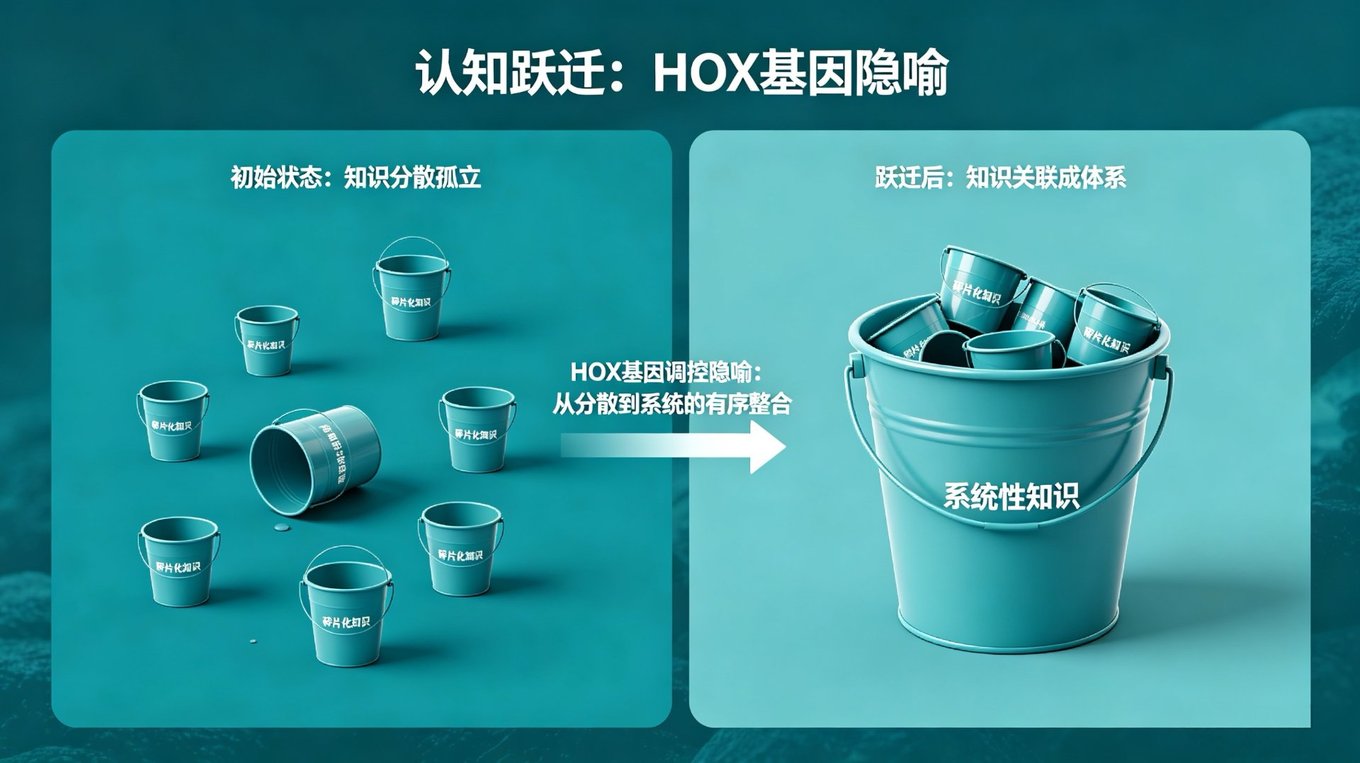 ▲ The Cognitive Leap — The HOX Gene Metaphor: from scattered knowledge to systematic understanding, the bucket grows larger
DISCOVERY TWO: NICHE CONSTRUCTION
Odling-Smee proved something long overlooked: organisms don't just passively adapt to their environment. Beavers build dams. Earthworms aerate soil. Humans build cities. Organisms actively modify their environment, and the modified environment in turn redirects the course of evolution.
→ What this means for education: Students are not sponges. Students are beavers. Effective learners actively construct their own "cognitive niche"—note-taking strategies, questioning habits, learning tools.
Teaching knowledge, and teaching "how to build a cognitive niche," are two completely different kinds of education. The former gives students fish. The latter teaches them to dig ponds, raise fry, and improve water quality.
DISCOVERY THREE: PUNCTUATED EQUILIBRIUM
Eldredge and Gould demonstrated that species evolution is not uniform. Long periods of morphological stability—millions of years with virtually no change. Then environmental upheaval—rapid differentiation.
→ What this means for education: A student's understanding is never a smooth upward curve. There are explosive phases. There are plateau phases. In my years as a principal, one of the greatest pressures has been "proving to parents that teaching is effective." But evolutionary theory tells me plainly: those "stagnation periods" that can't be measured are precisely the most critical incubation periods.
Short-term measurement showing no effect does not mean learning isn't happening. Gould put it even more directly: "Stasis is not nothing—it is data."
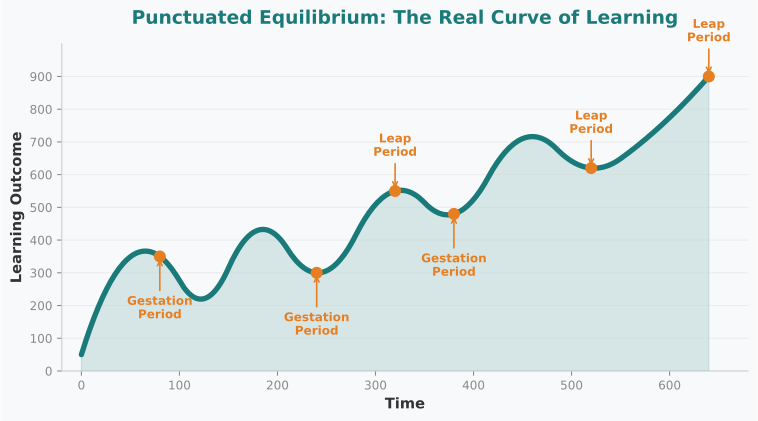 ▲ Punctuated Equilibrium — The Real Curve of Learning: sawtooth curve showing "gestation periods" and "leaps", not smooth progress
Three Educational Principles
PRINCIPLE ONE
The first principle of education is not "teaching"—it is "adaptation." The brain is born to learn. 3.8 billion years of evolution have already etched "Variation → Selection → Retention" into the operating logic of every neuron. The task of education is not "cramming knowledge into the brain"—it is creating the conditions for the brain's natural learning algorithm to operate efficiently.
PRINCIPLE TWO
The speed of learning depends on the density of feedback loops, not the density of information. What truly determines learning efficiency is how many complete "Variation → Selection → Retention" cycles a student experiences per unit of time.
A good class is not the one with the most information—it's the one with the most cycles.
PRINCIPLE THREE
The most valuable ability to teach is the ability to "construct a cognitive niche." Teaching knowledge is giving someone a fish. Teaching study methods is teaching someone to fish. Teaching "the ability to construct a cognitive niche"—is teaching someone to build a fishery.
◆
DIMENSION TWO
Social Evolution: From "I Learned It" to "Civilization Advanced"
A student solves a math problem. A civilization invents writing. A science undergoes a revolution.
Three things. One path.
Individual Learning and Organizational Evolution Are Fundamentally the Same Thing
Vygotsky said that "higher psychological functions originate in social interaction." I want to push this statement one step further today:
Not only does individual cognition originate in social interaction—the evolution of social organizations themselves follows the same logic as cognitive construction.
Individual Learning
Organizational Evolution
Keyword
① Encounter an unfamiliar problem
→
① Organization faces a new challenge
Old structure insufficient
② Draw on existing knowledge to attempt
→
② Team designs solutions based on experience
Drawing on reserves
③ Trial and error, get stuck, seek help
→
③ Collective deliberation, debate, tear down and restart
Cognitive conflict
④ Finally figure it out
→
④ New solution validated through practice
Accommodation & restructuring
⑤ Internalized as problem-solving ability
→
⑤ Sedimented as "organizational memory"
New equilibrium
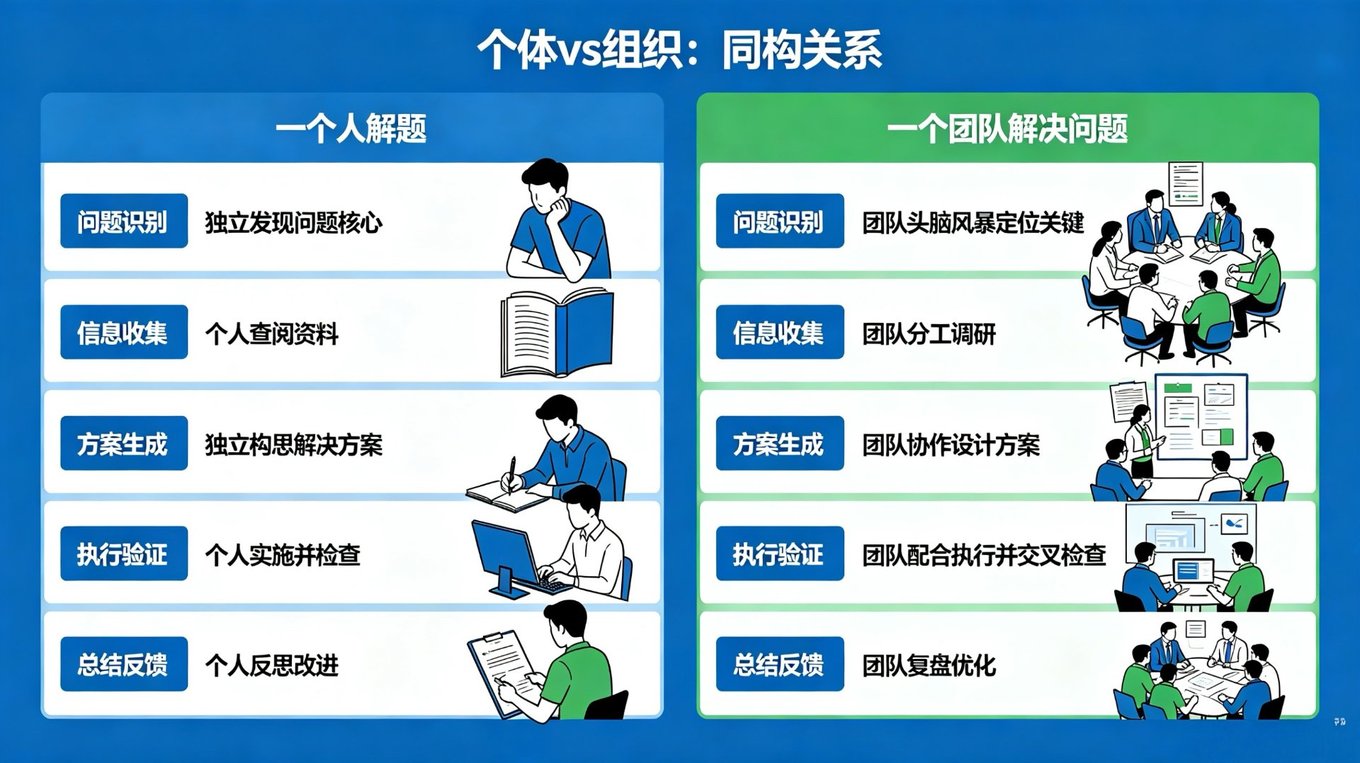 ▲ Individual vs Organization — Isomorphic Relationship: left side "one person solving a problem", right side "a team solving a challenge", five steps mirror each other
The Collective Construction of Civilization: Three Pieces of Historical Evidence
CASE ONE: HOW SCHOOLS CAME TO BE
Schools were not designed by some sage sitting at a desk. Ancient Greek academies → Chinese private tutorial schools → modern subject-divided schools—every morphological shift followed the same cycle:
"The old form is no longer enough → try something new → the new form stabilizes → and then isn't enough again." What Yingjian is doing today—exploring new teaching models, new evaluation methods—is a contemporary page in this millennia-long constructive cycle. We are not "revolutionaries." We are relay runners.
CASE TWO: HOW SCIENCE PROGRESSES
Kuhn's theory of paradigm shifts traces a clear arc: normal science (assimilation phase) → anomaly accumulation (cognitive conflict) → crisis (disequilibrium) → scientific revolution (accommodation) → new normal science (new equilibrium). This rhythm and the cognitive development Piaget described in children are
not metaphorically "a bit similar"—they are structurally "isomorphic."
CASE THREE: HOW LANGUAGE GREW
No one "designed" Chinese. Yet Chinese has an exquisitely precise grammatical system. This was collectively constructed, bit by bit, by millions of people across hundreds of years of everyday communication. A school's "ethos" works the same way—it is not molded by a single speech from the principal. It is an emergent product, slowly deposited like a coral reef through the daily interactions of all teachers and students.
 ▲ Emergence of Collective Construction — Coral reef or beehive: tiny individual contributions accumulating over time into complex order
Three Insights for Educators
INSIGHT ONE
Schools are "grown," not "managed." Rules can manage behavior. But they cannot manage culture. Culture can only be seeded, watered, and left to grow.
A good principal knows in their heart: the construction of school culture has its own clock.
INSIGHT TWO
Collaborative teacher learning is the best form of "collective learning." Effective collaborative learning is, in essence, a "collective cognitive construction system." Run your teaching-research group as an administrative unit—and teaching dies. Cultivate it as a "collective cognitive construction system"—raise questions, create friction, let everyone contribute, allow trial and error—and teaching becomes the school's most powerful engine of innovation.
INSIGHT THREE
Educational reform must align with the rhythm of organizational construction, not the rhythm of administrative commands. It takes two to three years for a teacher to go from "knowing about a new teaching method" to "using it naturally." It takes four to five years for parents to go from "scores are everything" to "seeing that learning ability is growing." Using an administrative clock to measure organizational seasons—is like using the rhythm of growing vegetables to measure the growth of a tree.
A good principal must hold two clocks in their heart simultaneously. One for days. One for seasons.
◆
DIMENSION THREE
The Coevolution of Individual, Community, and Environment
After years as a principal, one feeling has grown increasingly intense:
The environment is not a backdrop. It is alive.
Traditionally, we treat the school environment as "operational conditions"—adequate facilities, sound systems, good atmosphere, and out come good students. A neat one-way arrow.
But what I've seen at Yingjian is not like that.
A student opens a textbook and, in the moment they draw their first underline—they are no longer merely a "user of the textbook." They have become a constructor of the textbook. The textbook they've annotated will now act upon them in a completely different way. Their attention will wander on its own toward the annotated passages.
They are transforming their environment. And the transformed environment is, in turn, transforming them.
This is not a metaphor. In evolutionary biology, there is a precise concept called niche construction—a beaver building a dam is not merely adapting to its environment. It is changing its environment. And the changed environment in turn alters the evolutionary trajectory of the beaver.
What learners do every day is niche construction at the cognitive level.
"
Learning is not a one-way process of a subject adapting to an environment,
but a perpetual cycle of subject and environment mutually shaping each other.
"
Traditional Education View
- Knowledge is "objective truth"
- Teacher is "transmitter of knowledge"
- Student is "receptacle for receiving knowledge"
- Environment is "static classroom hardware"
- Assessment = accuracy of recall
Constructivist Education View
- Knowledge is "meaning constructed by the subject"
- Teacher is "designer of cognitive environments"
- Student is "active constructor of meaning"
- Environment is "living interactive niche"
- Assessment = growth of constructive ability
 ▲ Niche Construction — Students Transforming Their Learning Environment: textbooks covered in annotations, the textbook shifts from "knowledge container" to "cognitive tool"
Micro Level: Students Transform Their Cognitive Niche Every Day
Xiao Chen is in evening self-study. He underlines key passages in the textbook. He writes "common mistake" in the margins of his scratch paper. He sticks orange post-it notes in his error notebook.
What is he doing? He is transforming his own learning environment.
His annotated textbook is no longer a "knowledge container." It has become a "cognitive tool." Like a beaver's dam—what appears to be a modification of the environment is, in truth, an extension of capability.
INSIGHT FOR EDUCATORS
When evaluating teaching effectiveness, don't just look at scores. Go and see: are students embracing learning, or trying to escape it? Is their state in the classroom energizing or draining? Are they merely passive recipients, or actively transforming their cognitive environment?
The answers to these questions are far more honest than scores.
Meso Level: The Classroom Is a Micro-Society, Grown Together by Teachers and Students
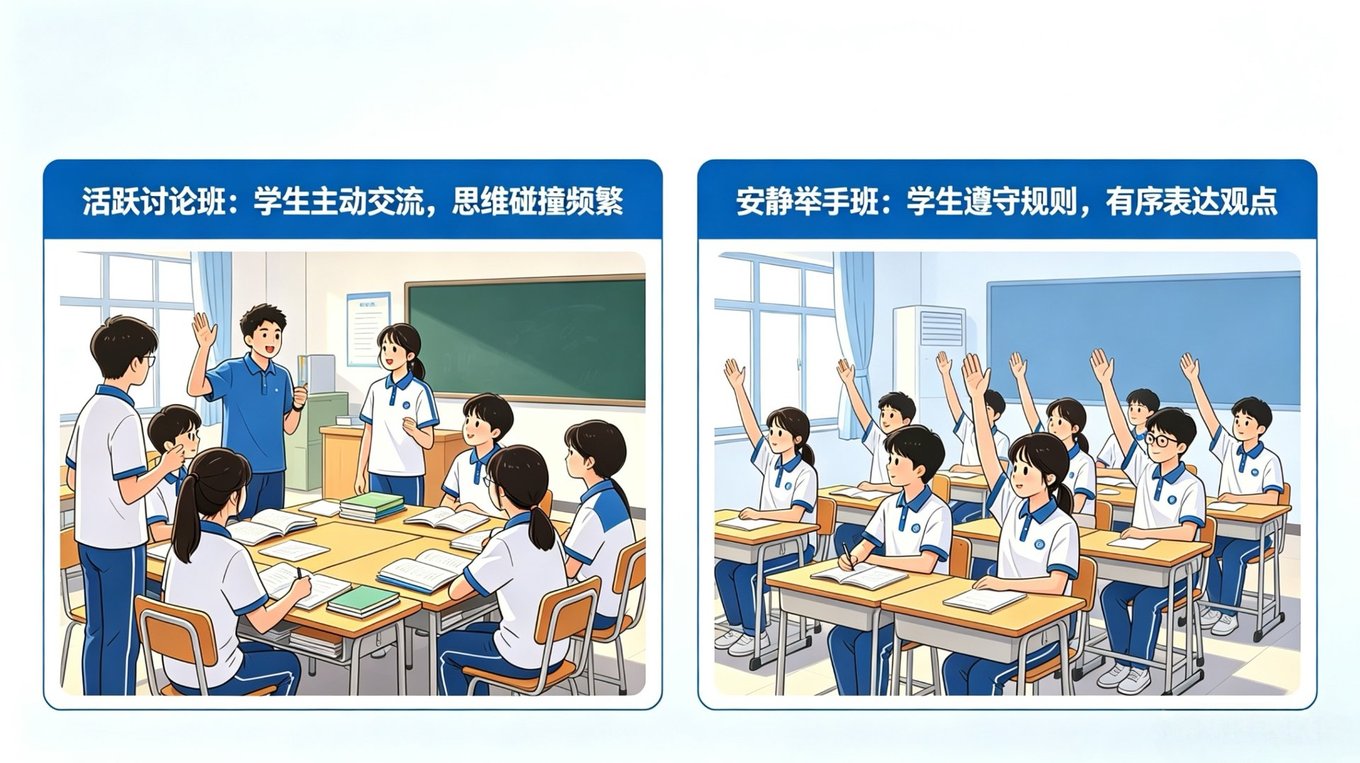 ▲ How Classroom Culture Emerges — Contrast between two parallel classes: one lively with discussion, the other quiet with raised hands
Imagine a scene.
The first week of school. Two parallel classes, both quiet. Everyone is observing: "How should one speak in this class?"
The second day, subtle differences begin to surface. In Class A, someone murmurs a response to the teacher's words. In Class B, no one does.
A week later—Class A has developed a culture of "calling out answers without raising hands." Not because it was permitted. It grew organically. Class B has formed the tacit understanding of "must raise hand and wait to be called on." Also not because it was required. It too grew organically.
By semester's end, the two classes' "ways of speaking" are completely different. Same teacher. Same textbook. Same disciplinary requirements.
No one "designed" this difference. It is the result of dozens of lessons, hundreds of interactions, each tiny difference accumulating, being amplified, ultimately emerging as two entirely different collective behavior patterns.
ONE TEACHER RESPONSE CAN CHANGE THE COURSE OF A RIVER
The first student gives a wrong answer. The teacher frowns and says, "Wrong, sit down"—or follows up with, "That's an interesting angle—can you elaborate?"
This
microscopic interaction sends a signal to the whole class. This signal is not "announced"—it is
"demonstrated." From that moment on, it becomes part of this class's niche.
You cannot change classroom culture by holding a class meeting. You can only change it through—
persistently altering the pattern of each microscopic interaction.
Macro Level: School Systems Are Organizational-Level Niches
Why did the Progressive Education Movement, launched by Parker and Dewey in the late 19th century, fail?
Not because the pedagogy was bad. Experimental schools proved—they were excellent.
The problem was: a mismatch between pedagogy and the institutional niche.
Exams only tested "memorization of standard answers." But the pedagogy required "student-led inquiry." Teachers were pulled in two opposite directions. In the end, the exam system won.
This is not a story about "who is right and who is wrong." This is a story about "slow variables and fast variables." The exam system is a slow variable. Pedagogy is a fast variable. Fast variables are always dragged back to square one by slow variables.
FOUR HONEST QUESTIONS TO FACE
1.
What is the core metric of your evaluation system? Final scores, or construction along the way? When the system says "scores are what matter most," whatever you say is powerless.
2.
What does your teacher development mechanism reward? "Innovate in teaching and don't penalize failed innovations" or "safety first"?
3.
How much freedom of choice does your curriculum give students? Is the system saying "your choice matters" or "follow the standard"?
4.
Does your home-school communication help parents understand that "construction takes time"? Short-term score fluctuations are not failure. They are incubation.
Cyclic Model: Three Layers Interlocked
↺ Interlocking and Feedback of the Three Learning Layers
Macro
Macro Layer
Institutional niche · Evaluation system · Teacher development · Curriculum architecture
Meso
Meso Layer
Classroom culture · Teacher-student interaction patterns · Questioning mechanisms · Error tolerance
Micro
Micro Layer
Cognitive environment · Student annotations · Knowledge network construction
Three layers nested into one another, with continuous bidirectional feedback—no starting point, no ending point
Mi
Micro Layer
Students transform cognitive environment · annotate textbooks · build knowledge networks
↓ Daily interactions accumulate
Me
Meso Layer
Teacher-student interactions emerge into classroom culture · questioning patterns · error tolerance
↓ Culture solidifies, becomes institutionalized
Ma
Macro Layer
Institutional niche forms · evaluation system · teacher development · curriculum architecture
↑ Institutional constraints feed back
↺ Cycle has no start or end; direction can be positive or negative
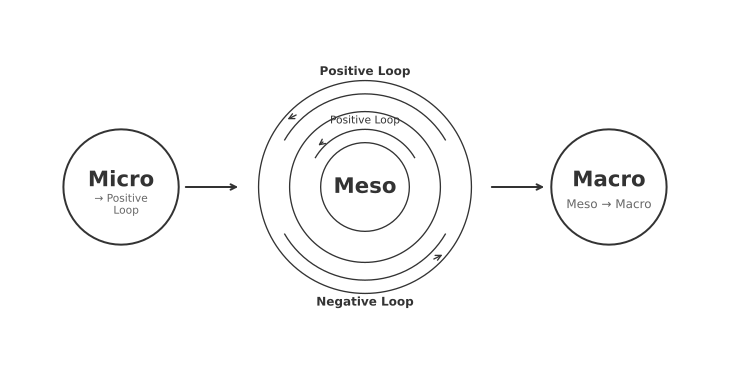 ▲ The Three Nested Cycles — Micro → Meso → Macro, bidirectional feedback, positive and negative loops annotated
This is not a linear causal chain. This is a cycle with no starting point and no ending point.
A positive cycle goes like this: students actively construct → classrooms are open and accepting → institutions encourage innovation → students gain more space.
And the negative cycle? You can guess. Students passively receive → classrooms grow increasingly rigid → institutions grow increasingly strict → students become even less willing to move.
Both cycles are self-reinforcing. Once you've entered one of them, it's very hard to jump out on your own.
THE MOST PRACTICAL BREAKTHROUGH POINT
At the meso layer. The micro layer is too dispersed—you can't monitor every student one-on-one as they transform their cognitive environment. The macro layer is too heavy—changing the evaluation system requires time measured in "years." But the way a teacher responds each moment—that can be changed right now. It is actionable. It is visible. It has a diffusion effect.
One teacher changing their interaction pattern can influence dozens of students. Dozens of teachers changing can shake institutional inertia. Finland's educational reform began precisely with "changing teachers' classroom practice," and then filtered upward.
🌲
A school is not a building.
It is a forest.
A tree transforms the soil structure through its roots, the light distribution through its canopy, the nutrient cycle through its fallen leaves.
The transformed soil, light, and nutrients in turn transform that tree—and every tree around it.
A forest is not a collection of trees. A forest is the infinitely complex web of interactions between trees, and between trees and their environment.
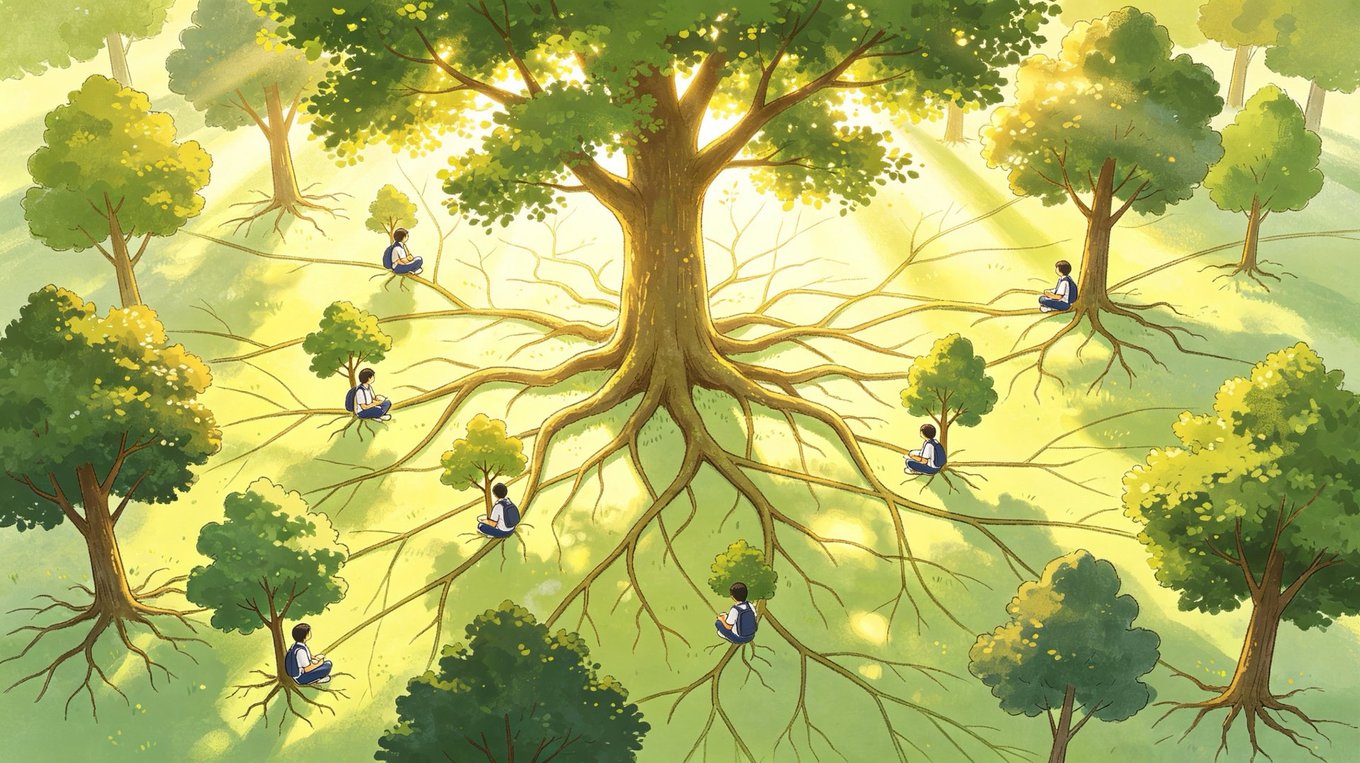 ▲ Forest Imagery — A school is not a building, it is a forest. Each tree is a student, roots intertwined, sunlight filtering through the canopy
"
Our task is not to "build a fine environment for students to enter."
Our task is:
To make the soil of the school support every student in becoming a tree that can transform the soil.
"
◆
REFORM IN PRACTICE
Don't Just Change the Classroom—Change the Entire Ecosystem
This section is addressed to school principals.
The laws of constructivism apply not only to a student mastering one problem—they also apply to a school becoming better. The underlying logic is the same: the old structure becomes insufficient → try new approaches → the new structure stabilizes → encounter new problems again.
The only difference: a student might complete one cycle in 15 minutes, but school reform requires three to five years. The problem is, the outside world won't wait three to five years for you. Higher-level evaluations operate on semesters, parental anxiety operates on monthly exams, institutional inertia operates on decades.
You advance reform in "years," but the system applies pressure in "months."
This mismatch is the true root cause of reform failure.
The Progressive Education Movement (1919–1955) is the most harrowing example. An eight-year empirical study (Aikin, 1942) proved that progressive education students significantly outperformed traditional students in critical thinking and social skills—but in 1957, the moment the Soviet Union launched Sputnik, the entire movement was overturned. It wasn't that the philosophy was wrong. It was that the environment wouldn't allow it to survive.
FOR THOSE UNDERTAKING REFORM TODAY
Don't just change the classroom—
classroom teaching, evaluation systems, teacher development, and parental understanding—these four links must advance in sync. If any one of them stays still, the other three will be dragged back.
Don't try to overturn the entire system in one stroke—
first get it working in one class, one teaching-research group. Use the results you produce to earn a voice.
Say it clearly from the beginning: "This will take at least three years. Scores may fluctuate in the first half-year—this is normal." And throughout the process, demonstrate intermediate outcomes—student engagement, learning motivation, quality of work—so the outside world can see that reform is underway.
◆
CONCLUSION
To Speak Honestly
Constructivism is not a panacea.
Literacy, arithmetic, spelling—these foundational skills must be practiced before they can be understood. Not all learning is suited for constructivist approaches. It's not opposition—it's sequencing.
It cannot change poverty, family background, or social injustice. A child who hasn't had enough breakfast—telling them to "please construct the meaning of knowledge on your own"—that is the very definition of "let them eat cake."
The honesty of the Constructivist Philosophy of Education lies not in claiming to be all-powerful, but in acknowledging: education is, first and foremost, that thing that happens inside the learner's own mind. No external force—teacher, textbook, exam—can substitute for it.
It returns the sovereignty of learning to the student. It returns professional dignity to the teacher.
You are a designer, an observer, a conversational partner—knowing when to reach out and when to pull back. This is very hard. And precisely because it is hard, it is what makes it "professional."
When everyone is saying "pour more, pour faster,"
this voice says:
Stop. Look and see if the student's own fire is burning.
Once that fire catches, you don't need to pour anymore.
Laozi said, "The Dao follows what is natural."
Darwin said, "Variation, selection, retention."
Piaget said, "Assimilation and accommodation."
All saying the same thing:
What grows of its own accord is what truly grows.
Education is the evolutionary process by which life,
in deep interaction with its environment,
through honoring differences, collaborative construction, and sustained creativity,
continuously transcends itself.
Wang Sai
Founder & Principal, Yingjian Education Group
Twenty years in education. Believes the essence of learning is not infusion, but growth.
"Shape the world for a better future"
May 2026 · First published on WeChat Official Account